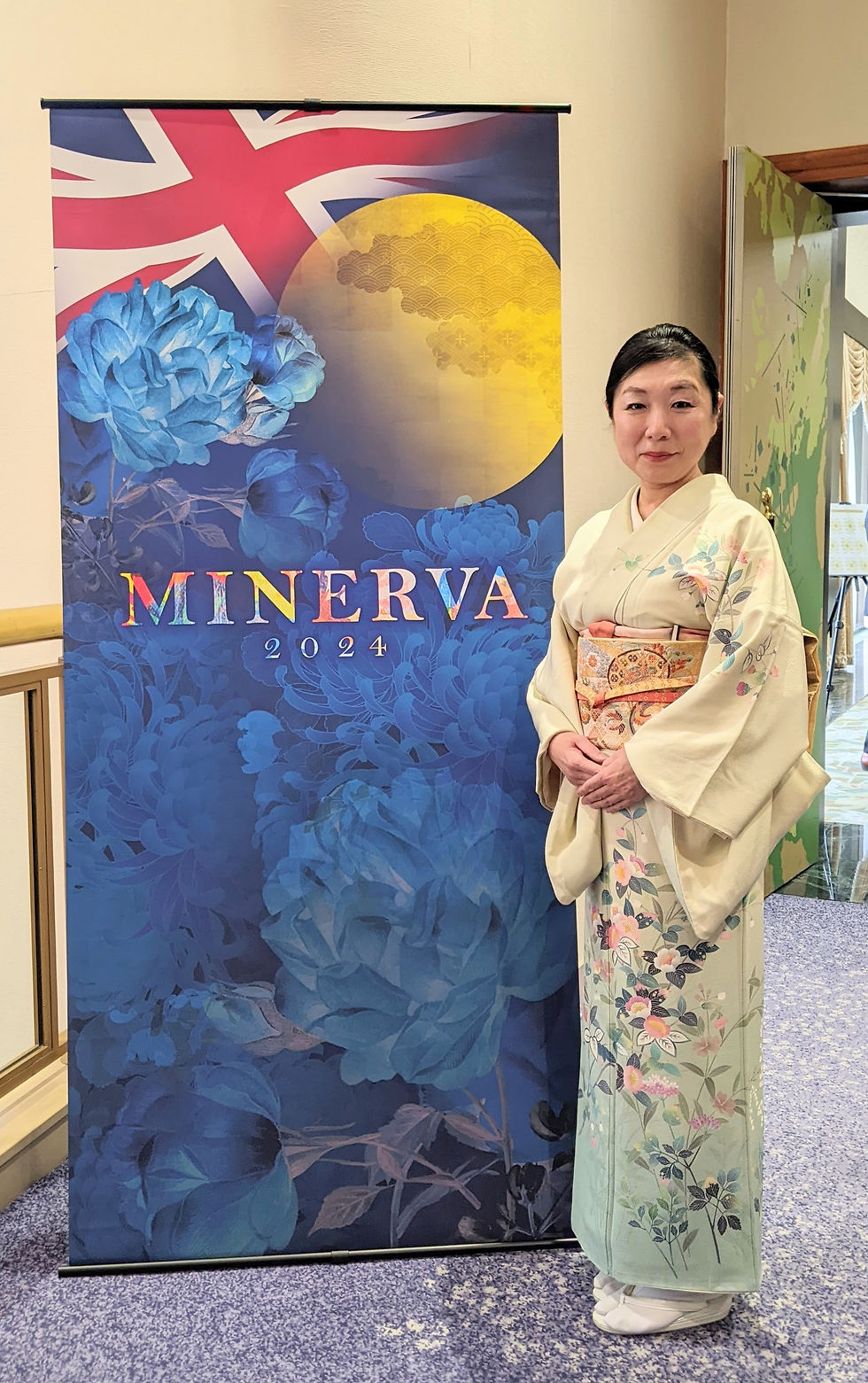
She Kept Drawing: Kumi Matsukawa and the Art of Seeing
From classrooms and commercial illustration to streets, courtrooms and communities of sketchers, Kumi Matsukawa has built her life around one enduring act: looking carefully at the world and drawing what she sees.
By BeART World JOURNAL

There is a particular kind of artist who does not arrive with a single dramatic turning point. Instead, she keeps going. Through changing careers, different materials, and new places, she returns to the same essential practice: she looks, and she draws.
Kumi Matsukawa's story is one of that kind of consistency. She studied painting, worked as an illustrator, drew storyboards for television commercials, contributed to newspapers and picture books, taught watercolor, painted outdoors, worked as a courtroom artist, and helped build a community around drawing the world as it is seen. Across all these chapters, drawing remained the thread.
Matsukawa describes her process as a kind of “dictation”: seeing reality and transcribing it through her eyes and hands. She wants her paintings to give people a sense of being there—to make them feel they might want to visit a place, or perhaps that they already have. It is a simple description, but it reveals something central to her practice. She begins with the world in front of her—a place, a changing sky, a building, a street, or a courtroom—and then comes the act of paying attention.
Learning to See—and Showing Others
Matsukawa studied oil painting at Musashino Art University before moving into commercial illustration. She worked on storyboards for television commercials, creating images designed to communicate a scene clearly through a single frame, while her career also included illustration for newspapers and picture books.
Then an unexpected change in her community led her further into teaching. A watercolor teacher became ill and later passed away, leaving behind students who needed someone to continue their classes. Matsukawa stepped in, and what began as an act of continuation would become an important part of her own artistic development.
Teaching required more than explanation. Again and again, she needed to demonstrate—to show how a composition begins, how color is applied, and how an observed scene gradually takes shape. Through years of repeated practice, her own approach developed. Rather than beginning with a conventional pencil underdrawing, she started lightly marking her compositions with crayon or colored pencil before applying watercolor. Pinks and oranges could remain visible beneath the washes, becoming part of the finished image rather than disappearing completely.
The method emerged through practice. The more she painted in front of others, the more clearly her own way of seeing took shape.
What You See When You Look
Much of Matsukawa's work begins with direct observation. One of her shrine paintings was made on location during a single outdoor sitting. An old shrine stands beneath dense trees, where stone lanterns, a courtyard, and touches of red create a recognizably Japanese setting.
Yet the painting is more than a record of a building. It captures a particular moment: light moving through the trees, shadows falling across the stone, and the atmosphere created by the relationship between wooden structures and surrounding greenery. Rather than copying every detail, Matsukawa uses line, color, and composition to convey the experience of standing there.
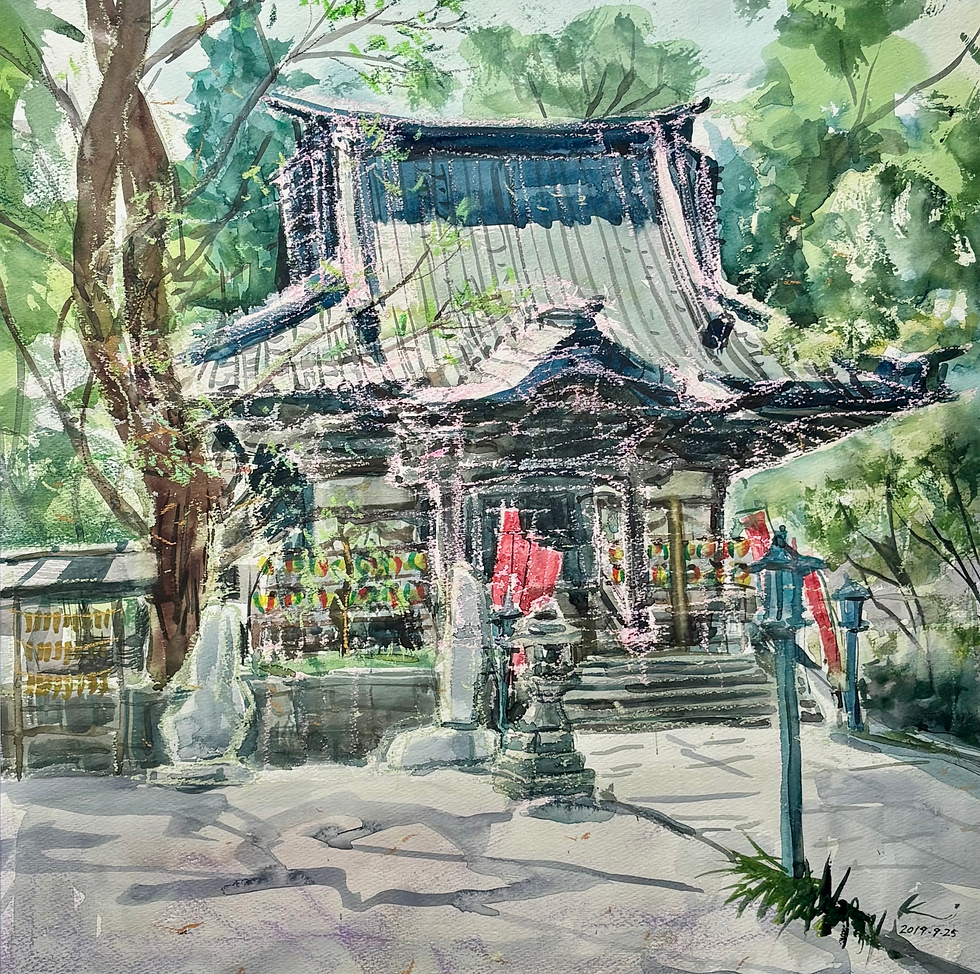
To draw directly from life is not simply to reproduce what stands in front of you. A place changes with weather, light, time, and the position of the person observing it. The artist responds to one set of conditions that will never appear in exactly the same way again.
This is where Matsukawa's idea of “dictation” becomes especially meaningful. Reality passes through her eyes and hands, and the finished image becomes more than a representation of a shrine. It becomes an encounter with a place as she experienced it.
When the Whole Body Enters the Work
Observation takes on another dimension in Matsukawa's larger works. She paints on large pieces of raw cloth spread across the ground, working at a scale that changes her relationship with the surface. The work cannot be completed simply by sitting in front of it at arm's length. She moves across the fabric, lies down, and works close to its surface as the composition develops.
She has described the experience as feeling like a child playing in sand. One of these works is a panoramic harbour scene stretching approximately two meters across raw fabric, where cranes, docks, buildings, vehicles, and a wide expanse of sky become part of a single composition.
The scale makes the physical process visible. A watercolor painting is often imagined as something made quietly, with the artist seated before a sheet of paper, but here the body enters the work differently. Matsukawa moves through the composition section by section as the image takes form, making drawing a physical act in which the hand is no longer working alone.
Drawing Together
In 2009, another important chapter of Matsukawa's story began when she joined Urban Sketchers, the international community centred on drawing on location from direct observation and sharing the results. As a correspondent for the international Urban Sketchers blog, she connected with sketchers in different parts of the world and discovered the pleasure of drawing alongside people who shared the same impulse: to go outside, observe, and record what was in front of them.
She wanted to create opportunities for people in Japan to experience that as well. From this came Urban Sketchers Japan. Matsukawa helped build spaces where people could connect and share their work through a blog, Flickr, Facebook, and free sketching sessions. Participation was not limited by professional status or artistic experience. There was no requirement to be an established artist, no fee to belong, and no fixed hierarchy determining whose way of seeing mattered more. The invitation was simple: come, draw, and share what you see.
Drawing alongside others creates another kind of learning. People can stand in the same place and see entirely different things. One person notices an architectural detail, another follows a passing figure, while someone else is drawn to a reflection, a shadow, or the movement of clouds.
Matsukawa herself has spoken about being influenced by the people she draws alongside—their materials, their handling of light and shadow, and their individual ways of approaching a scene. Her practice is deeply personal, filtered through her own eyes and hands, but it is not closed. She continues to learn by seeing how others see.
Presence in a Changing World
Matsukawa's career has moved across several forms of image-making: fine art, commercial illustration, teaching, watercolor, and courtroom drawing. As a courtroom artist, she draws live legal proceedings as they unfold. The work demands concentration and the ability to respond to what is happening in real time, returning her once again to the central discipline that runs through her practice: presence.
Her career has also unfolded during a period in which image-making is changing rapidly. Yet much of her work remains rooted in something fundamentally direct: the relationship between a person, a place, and a moment of attention.
A changing sky, an ordinary street, a harbour, or a courtroom can all become subjects because someone chooses to stop and look. The finished image may show a place or an event, but the work begins earlier—with the decision to be present enough to notice. These experiences cannot be entirely separated from the person who was there.
The Art of Paying Attention
There is a quiet consistency in Kumi Matsukawa's story. Her career has not remained inside a single category. She has moved between painting, commercial illustration, teaching, courtroom drawing, and community building. She has worked on paper and across large expanses of raw fabric, drawn alone, and helped create spaces where others can draw together. But the central act has remained remarkably stable. She looks, she draws, and then she looks again. Perhaps that is why her description of painting as “dictation” feels so fitting. She begins with what is already there and responds to it through her own experience and hand. A shrine becomes more than a building because of the particular conditions of the day. A harbour becomes more than infrastructure because of the sky surrounding it. An ordinary street becomes worth drawing because someone stopped long enough to notice.
Through decades of work, Matsukawa has developed her own ways of making those moments visible. Her crayon and watercolor technique grew through teaching, while her large-scale fabric paintings brought her entire body into the creative process. Through Urban Sketchers Japan, her commitment to direct observation also became something she could share with others.
Her work returns, again and again, to a simple idea: there is value in paying attention to the world in front of us. Through changing careers, different materials, different scales, and different communities, Kumi Matsukawa has continued the same essential practice.
She kept drawing.
About the Creator
Kumi Matsukawa
Artist · Illustrator · Founder of Urban Sketchers Japan · Kanagawa, Japan
Kumi Matsukawa is an artist, watercolor and ink illustrator, and founder of Urban Sketchers Japan. Her work spans fine art, commercial illustration, teaching, and live courtroom drawing, with a practice rooted in direct observation and the experience of recording the world as it is seen.